Private health insurance in Germany, independent advice in English

What it costs, whether you qualify, how to switch: one free call.


In short
How does private health insurance in Germany work?
What it is
Private health insurance (PKV) is your own contract instead of public cover. Your premium is set by your age and health when you join, not by your salary. Your benefits are fixed in the contract.
Who can join
Employees earning over €77,400 a year (2026) can choose it, whatever their nationality. After a pay rise, the new salary must also clear next year’s limit. The self-employed and civil servants can at any income.
What it costs
In 2026, private cover at 30 costs you €250 to €300 a month after your employer’s share. Public cover costs you €648 a month.
Why go private
Better care, often for less

See a specialist sooner
In our August 2026 study, private patients typically got a specialist appointment in 7 days. Public patients waited 21 days.
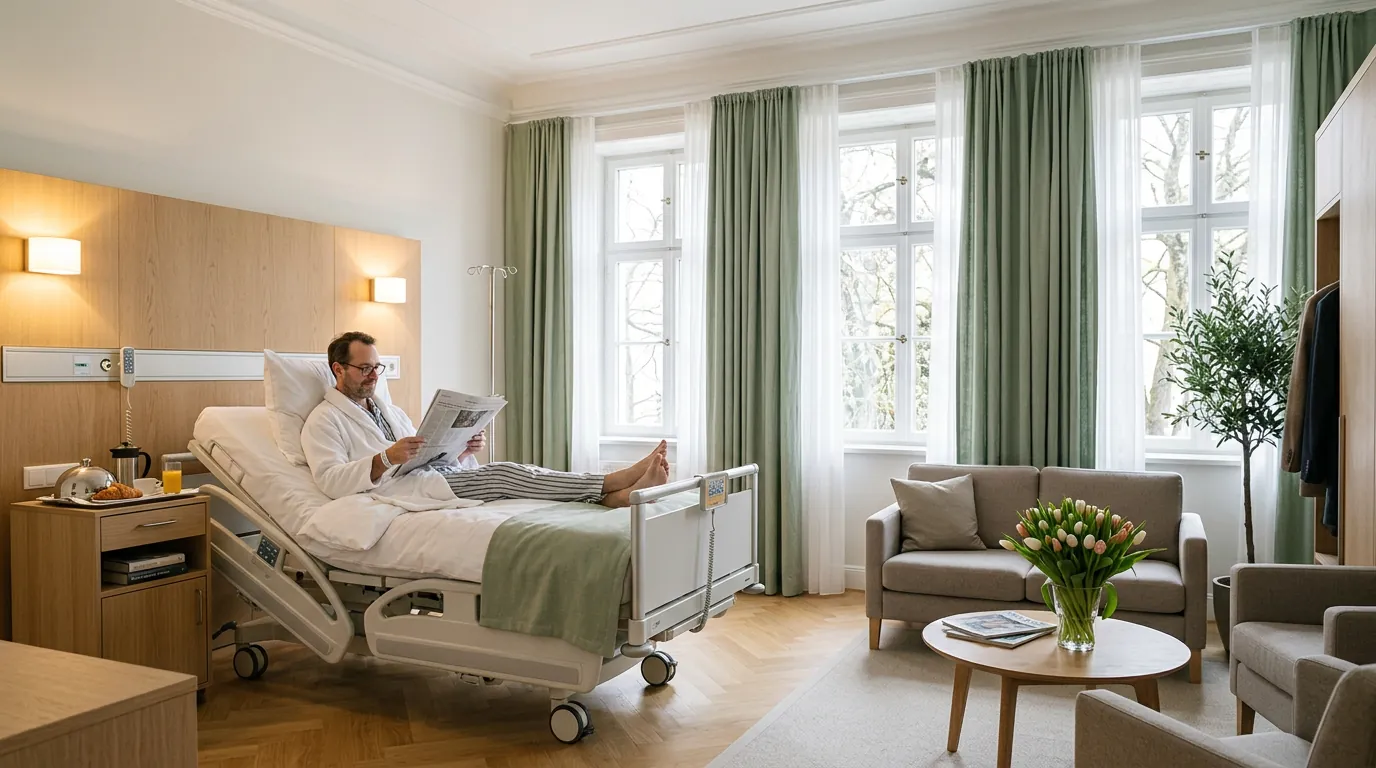
Single room, your doctor
In hospital you get a single room and the senior consultant. Private-only practices are open to you.

Dental work covered
Crowns, implants, inlays: your contract covers 80–90%. Public cover pays €239 a crown.
Healthy years pay back
Claim-free years earn up to six monthly premiums back.
Reviews
What clients write
5.0

Jonas Marx
Licensed insurance broker · register no. D-ON7P-Y7Q94-16
- Advising since
- 2018
- English-speaking clients
- 900+
Cost and cover
How much is private health insurance per month?
Employees pay €250 to €475 a month after the employer’s share. Your premium depends on your age when you join, your health and your cover, not on your salary. Public cover costs you €648 a month in 2026. Its maximum has almost doubled since 2010. Your employer pays half for you and your children, at most €613.22 a month in total. If you are self-employed, you pay it all, and a higher deductible brings it down. Your own figure, family included, we work out in a free call. Book a free call

Choose a level to compare
Medium: Entry plus hospital comfort, around €350 a month. Public: €648 a month
| Public | Private Entry | Private Medium | Private Max | |
|---|---|---|---|---|
| Who can join | Compulsory below €77,400 | Above €77,400, or self-employedPublic: Compulsory below €77,400 | Above €77,400, or self-employedPublic: Compulsory below €77,400 | Above €77,400, or self-employedPublic: Compulsory below €77,400 |
| Premium based on | Your income | Age and health at entryPublic: Your income | Age and health at entryPublic: Your income | Age and health at entryPublic: Your income |
| Health questions | None | Yes, after an anonymous pre-checkPublic: None | Yes, after an anonymous pre-checkPublic: None | Yes, after an anonymous pre-checkPublic: None |
| Deductible | None | Your choicePublic: None | Your choicePublic: None | Your choicePublic: None |
| Contract length | Open-ended | For lifePublic: Open-ended | For lifePublic: Open-ended | For lifePublic: Open-ended |
| Public | Private Entry | Private Medium | Private Max | |
|---|---|---|---|---|
| Typical wait for a specialist | 21 days | 7 daysPublic: 21 days | 7 daysPublic: 21 days | 7 daysPublic: 21 days |
| Choice of doctor | Contracted doctors | Any doctor, private practices tooPublic: Contracted doctors | Any doctor, private practices tooPublic: Contracted doctors | Any doctor, private practices tooPublic: Contracted doctors |
| Your medicines | Up to €10 co-pay each | No co-payPublic: Up to €10 co-pay each | No co-payPublic: Up to €10 co-pay each | No co-payPublic: Up to €10 co-pay each |
| Psychotherapy | Hours capped per course | 30 sessions a yearPublic: Hours capped per course | 50–80 sessions a yearPublic: Hours capped per course | No session limitPublic: Hours capped per course |
| Public | Private Entry | Private Medium | Private Max | |
|---|---|---|---|---|
| Your room | Standard ward | Standard wardPublic: Standard ward | Single or two-bedPublic: Standard ward | Single or two-bedPublic: Standard ward |
| Who treats you | Doctor on duty | Doctor on dutyPublic: Doctor on duty | Senior consultantPublic: Doctor on duty | Senior consultantPublic: Doctor on duty |
| Public | Private Entry | Private Medium | Private Max | |
|---|---|---|---|---|
| Crowns and bridges | €239 a crown | 80–90% coveredPublic: €239 a crown | 80–90% coveredPublic: €239 a crown | 80–90% coveredPublic: €239 a crown |
| Implants | Nothing for the implant | 80–90% coveredPublic: Nothing for the implant | 80–90% coveredPublic: Nothing for the implant | 80–90% coveredPublic: Nothing for the implant |
| Dental, first years | Fixed sum per tooth | Limit lifts after 4–5 yearsPublic: Fixed sum per tooth | Limit lifts after 4–5 yearsPublic: Fixed sum per tooth | No limitPublic: Fixed sum per tooth |
| Public | Private Entry | Private Medium | Private Max | |
|---|---|---|---|---|
| Trips within Europe | Local public care | Covered as at homePublic: Local public care | Covered as at homePublic: Local public care | Covered as at homePublic: Local public care |
| Trips beyond Europe | No | 1–6 months a tripPublic: No | 1–6 months a tripPublic: No | No time limitPublic: No |
| Public | Private Entry | Private Medium | Private Max | |
|---|---|---|---|---|
| No-claims refund | €600, if you’re lucky | Up to 6 monthly premiumsPublic: €600, if you’re lucky | Up to 6 monthly premiumsPublic: €600, if you’re lucky | Up to 6 monthly premiumsPublic: €600, if you’re lucky |
| Sick pay after six weeks | Up to €135.63 a day | Your choice, up to your net payPublic: Up to €135.63 a day | Your choice, up to your net payPublic: Up to €135.63 a day | Your choice, up to your net payPublic: Up to €135.63 a day |
| Saving for old age | No personal reserve | Built into your premiumPublic: No personal reserve | Built into your premiumPublic: No personal reserve | Built into your premiumPublic: No personal reserve |
| Premium in retirement | Based on your income | Not tied to incomePublic: Based on your income | Not tied to incomePublic: Based on your income | Not tied to incomePublic: Based on your income |
What public cover costs
The most an employee pays in 2026 for health and long-term care, without children, at the average extra rate. Many funds charge more; below €69,750 a year, you pay less.
What a private level costs
What you typically pay as a healthy employee after your employer’s share (half the premium, at most €613.22), long-term care included. Self-employed? You pay the full premium.
What a private level costs
What you typically pay as a healthy employee after your employer’s share (half the premium, at most €613.22), long-term care included. Self-employed? You pay the full premium.
Who can join
In a new job paying over €77,400 a year (2026), you can choose private cover from day one, whatever your nationality. The self-employed and civil servants can at any income.
Health questions
Private insurers ask about your health before they accept you. We ask them anonymously first, so nothing goes on record until you choose.
Deductible
The part of your yearly medical costs you pay yourself. A higher deductible lowers your premium; we set it with you.
Contract length
Your private insurer can never cancel your cover because you fall ill or grow older. It runs for life, until you choose to end it.
Typical wait for a specialist
The median wait for an online-bookable specialist appointment in six German cities, from our study of 2,082 practices in August 2026.
Choice of doctor
Public patients see doctors with a public contract. Private patients can see any licensed doctor, including practices that only treat private patients.
Your medicines
In public cover you pay 10% of each prescribed pack, at least €5 and at most €10 (2026). Private cover pays your medicines under your tariff, without that co-pay.
Psychotherapy
Public cover approves therapy in set numbers of hours per course. Private tariffs set sessions per year, and top tariffs set no limit.
Your room
Public patients stay on a standard ward. Medium and Max cover a single or two-bed room, for more privacy and rest.
Who treats you
In public cover, the doctor on duty treats you. With Medium and Max, you are treated by the senior consultant.
Crowns and bridges
Public cover pays a fixed amount per crown, however much your crown costs. Private tariffs pay a share of the actual bill, so better materials are covered too.
Implants
Public cover pays nothing for the implant itself, only a fixed amount for the crown on it. Private tariffs pay a share of the whole treatment.
Dental, first years
At Entry and Medium, crowns, bridges and implants are paid up to a limit that rises each year and lifts after four to five years. Max has no limit.
How the dental limit works
At Entry and Medium level, crowns, bridges and implants are paid up to a total in your first years. In 2026 tariffs, that total starts at around €1,000 and rises each year. After 4–5 years, the limit lifts. Fillings, root canals and dental work after an accident sit outside it. Planning dental work soon? We pick a tariff with a short limit or none.
Trips within Europe
In the EU, Switzerland and the UK, the European Health Insurance Card gives public patients local public care, with its co-pays. Private cover pays as at home across Europe.
Trips beyond Europe
Public cover pays nothing outside Europe, apart from a few countries with an agreement. Private tariffs cover trips for 1–6 months, Max without a time limit.
No-claims refund
Depending on the tariff, private cover refunds up to six monthly premiums after claim-free years. A public fund refunds at most €600 a year, if it offers this.
Sick pay after six weeks
From week seven off sick, public cover pays at most €135.63 a day (2026), well below your net pay. You choose private sick pay up to your full net pay.
Saving for old age
Part of every private premium goes into a reserve that keeps your premium steadier as you get older. Public cover keeps no reserve for you.
Eligibility
When can you switch to private health insurance?
As an employee, you can go private once you earn more than €77,400 a year (2026), whatever your nationality. After a pay rise, your new salary needs to clear next year’s limit, which is €84,150 for 2027. If you are self-employed or freelance, you can go private at any income. Moving to Germany? You can take out private cover before you arrive. What counts towards your salary, and when exactly you can switch, we work out together in your first call. Book a free call

What is your situation?
Student, not in paid work or something else? Who can get private health insurance
Already private? We check for free whether you can pay less: book a call.
How it works
How long does the switch to private cover take?

From your first call to confirmed cover takes 24 hours to a few weeks. It depends on whether insurers need to look at earlier conditions or diagnoses. Your public cover only ends once your private cover is confirmed, so there is no gap.
- 1
A Zoom call in English
30 minutes
You leave with your likely premium and the option that suits you. Your Zoom link arrives by email when you book. No preparation, no obligation.
- 2
Anonymous pre-check
If needed: a few weeks
Insurers rate your health without your name. Nothing goes on record. You get a shortlist.
- 3
Application and aftercare
For as long as you are insured
We prepare the application with you and stay your contact.
Our advice costs you nothing. The insurer you choose pays us as your independent broker, and your premium is the same with or without one.
PKV or GKV
Is private health insurance worth it in Germany?
Private health insurance pays off if you are healthy when you join, earn well and want faster appointments and better dental and hospital care, often for less than the public maximum. Each person has their own policy, priced by age and health at entry. If your family lives on one income, public cover insures your children free. If you work part-time during parental leave, you can apply to stay private. For both, we compare the two systems for your household before you decide. Talk it through
| Private | Public | |
|---|---|---|
| Specialist appointment | 7 days | 21 days |
| Crowns and bridges | 80–90% covered | €239 a crown |
| Premium based on | Age and health at entry | Salary |
| No-claims refund | Up to 6 premiums | €600, if you’re lucky |
- Tariff switch: you can move up or down between your insurer’s tariffs as your needs change.
- Employer share: your employer also pays half of your children’s premiums.
- Premium-relief tariff: pay into it while you work, and your premium in retirement drops by €250 to €500 a month.
The full comparison: PKV or GKV, which is better for expats
Guides
Read more before your call




Independent
Which private health insurer is best?
There is no single best insurer. Yours has to pass four checks.
- 1
Accepts your health history: the anonymous pre-check shows which insurers do.
- 2
Covers what you want: hospital, dental, specialists, cover abroad.
- 3
Fits your budget: we set the deductible with you.
- 4
Stays a good partner: we track its premium history and review its finances every year.
Only insurers that pass all four make your shortlist.








FAQ
Before you book
Does the call cost anything?
What will you ask me?
Do I have to decide in the call?
Can we talk before my job starts?
Do I need to speak German?
Am I too old for private cover?
Does private cover make sense with a family?
Can I switch back later?
What if I leave Germany?
Sources and status ·
- [1]Sozialversicherungs-Rechengrößenverordnung 2026 (income limit €77,400, or €6,450 a month; contribution ceiling)
- [2]§ 5 Abs. 5 SGB V (no compulsory public cover for the self-employed in their main occupation, at any income)
- [3]§ 6 Abs. 4 SGB V (start after a pay rise, if the pay also clears the next year’s limit); § 175 Abs. 4 SGB V (notice; Satz 5: the notice takes effect only with proof of other cover); § 188 Abs. 4 SGB V; § 53 Abs. 8 SGB V (elective tariffs can bind members for one to three years)
- [4]§ 257 Abs. 2 SGB V and § 61 Abs. 2 SGB XI (employer contribution to private health and long-term care, also for a spouse and children who would be family-insured in public cover; at most half of the premium and at most €613.22 a month in total in 2026, €584.15 in Saxony)
- [5]§ 241 SGB V and § 55 SGB XI (contribution rates) with § 1 Abs. 1 PBAV 2025 (general long-term care rate of 3.6% since 2025), and the average additional rate for 2026 of 2.9%
- [6]TheGoodBroker Specialist Access Study, August 2026: 2,082 specialist practices in six cities; median wait for an online-bookable appointment
- [7]§ 17 Abs. 1, 3 and 4 KHEntgG (separately charged accommodation and the chosen doctor are elective services on top of general hospital care)
- [8]§ 76 SGB V (choice of doctor in public cover: contracted doctors; others only in emergencies, private practices only by cost reimbursement with the difference at your own cost, § 13 SGB V); § 4 Abs. 2 MB/KK (private cover: free choice among licensed doctors)
- [9]GKV-Spitzenverband, Festzuschussbeträge from 1 January 2026, finding 1.1 (crown, per tooth), 60%: €239.03; the amounts are set under § 57 SGB V; the hardship rate is capped at the actual costs (§ 55 Abs. 2 SGB V); § 55 SGB V as amended by the GKV-Beitragssatzstabilisierungsgesetz (the subsidy falls from 60% to 50% of the standard treatment in 2027; the 2027 euro amounts are not yet set). The implant itself gets no public subsidy (§ 28 Abs. 2 SGB V); the crown on it does.
- [10]Public maximum contribution for health and long-term care, employee and employer together, members without children: €641.25 a month in 2010, €1,261.31 in 2026 (+96.7%), from the contribution ceilings of the Sozialversicherungs-Rechengrößenverordnungen and the rates under § 241 SGB V, § 55 SGB XI and, from 2025, the PBAV 2025, as at 1 January of each year
- [11]§ 146 Abs. 1 Nr. 1 and 2 VAG (private premiums set by entry age and risk, with old-age provision) and § 149 VAG (10% surcharge until the end of the year in which you turn 60); § 220 Abs. 1 SGB V (public cover financed from current contributions)
- [12]§ 19 VVG (duty to disclose your health before the contract; the anonymous pre-check comes before it)
- [13]§ 206 Abs. 1 VVG (the insurer cannot give ordinary notice on health insurance that meets the duty to insure; only you can leave)
- [14]§ 61 SGB V (co-pay in public cover: 10% of the price, at most €10 a medicine, never more than its cost; 2026)
- [15]G-BA Psychotherapie-Richtlinie, §§ 29 and 30 (version of 19 March 2026): public psychotherapy in set hours per course of treatment
- [16]Regulation (EC) No 883/2004, Art. 19 (European Health Insurance Card: care within the local public system in the EU, the EEA and Switzerland; the UK under the EU–UK Trade and Cooperation Agreement) and § 13 Abs. 4 SGB V; § 16 Abs. 1 Nr. 1 SGB V (public benefits suspended abroad unless the Code or an agreement provides otherwise; social security agreements, for example with Turkey, Tunisia, Morocco, Serbia and Bosnia and Herzegovina, give care in the local public system there); § 1 Abs. 4 MB/KK (private cover in Europe, outside it for one month a trip unless the tariff gives more)
- [17]§ 53 SGB V (public premium refund: at most one twelfth of the year’s contributions, at most €600, only where the fund offers it)
- [18]§ 47 Abs. 6 SGB V (public sick pay: at most €135.63 a day gross in 2026) and § 3 EFZG (six weeks of continued pay); § 192 Abs. 5 VVG (private daily sickness benefit, an add-on tariff)
- [19]§§ 237 and 240 SGB V (public contributions in retirement, on pensions and other income)
- [20]Sozialversicherungs-Rechengrößenverordnung 2027, draft of the Federal Ministry of Labour of 21 September 2026 (income limit €84,150 from 2027)
- [21]§ 10 SGB V (family insurance)
- [22]§ 8 Abs. 1 Satz 1 Nr. 2 SGB V (exemption from public cover on application for part-time work during parental leave, for the leave only)
- [23]§ 204 VVG (tariff switch without new health questions for the same or less cover)
- [24]§ 242b SGB V, inserted by the GKV-Beitragssatzstabilisierungsgesetz (surcharge for a family-insured spouse from 2028; exceptions include a child under 12 at home)
- [25]§ 6 Abs. 3a SGB V (rule from 55: five years outside public cover, at least half of them exempt or self-employed)
- [26]§ 207 Abs. 3 VVG (moving within the EU or EEA; the insurer pays at most the German level); dormant cover (Anwartschaft) under § 15 MB/KK and the tariff terms; public cover: membership usually ends on moving away, while § 240 Abs. 4b SGB V lets voluntary members keep it at a reduced contribution during a work-related stay abroad
Private figures: TheGoodBroker, typical premiums for healthy applicants joining between 30 and 45 in a very good tariff with a deductible of up to €600, long-term care included. Entry, Medium and Max: typical tariff levels from our market observation, as at October 2026; the tariff wording decides. Crowns, bridges and implants: typical reimbursement in good tariffs; dental limits apply for the first four or five years in many tariffs, from around €1,000 in year one, none in top tariffs. Premium refund: 1 to 6 monthly premiums, depending on the tariff and the number of claim-free years, set off against your tax-deductible contributions. Premium-relief tariff: paid into while working. Public figures: official amounts for members without children, long-term care included. Eligibility: private cover is open regardless of nationality. Legal position: as at October 2026.
Find out where you stand
Jonas MarxFounder, licensed insurance broker
A free 30-minute Zoom call in English. If public cover suits you better, we say so.
- Can you go private, and when
- Your premium against what you pay now
- The pre-check for your health
- Your own questions
Prefer to write first? Email us at info@thegoodbroker.de.